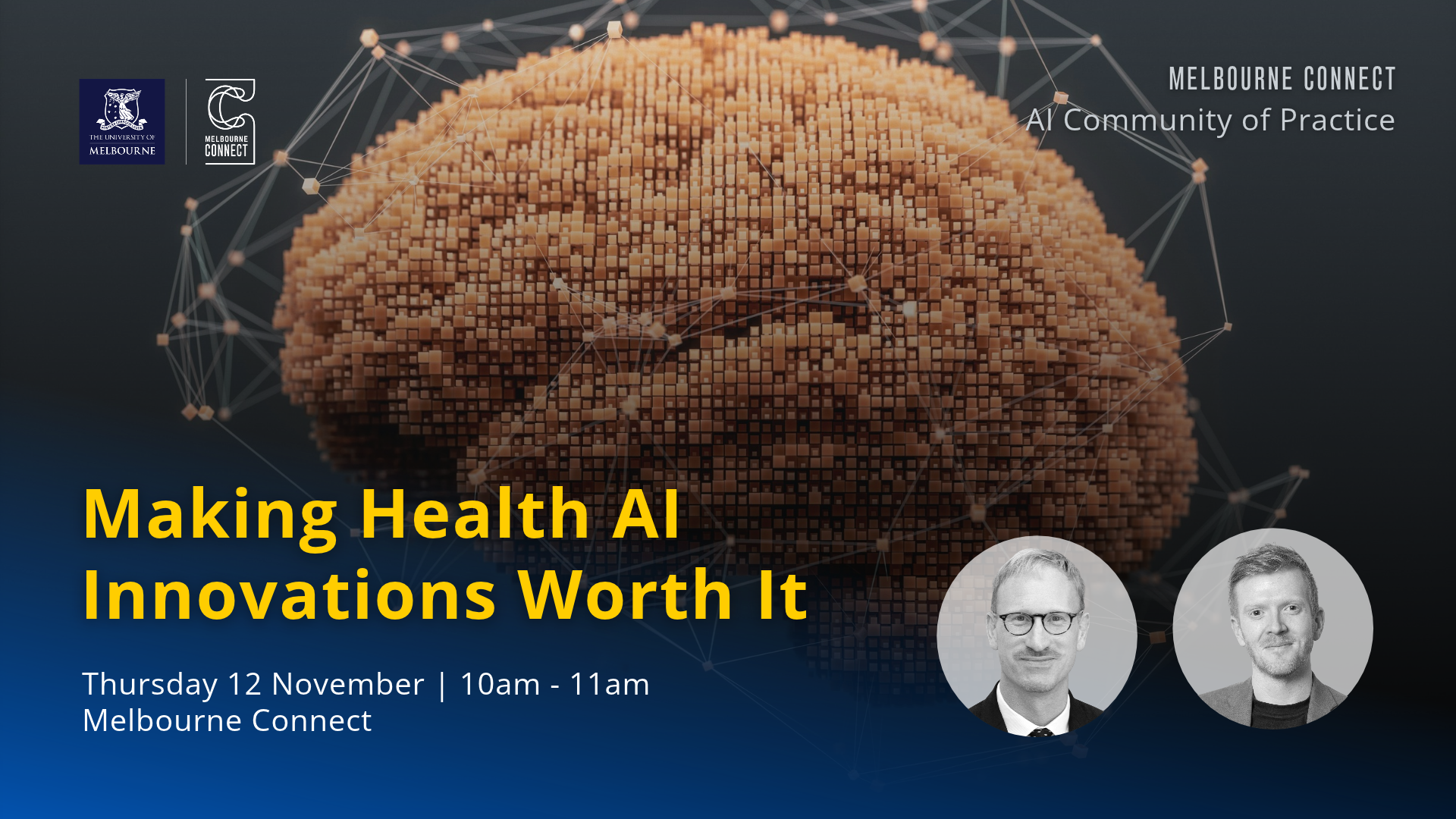
Join Peter Steel, Chief Transformation Officer at the Royal Melbourne Hospital, and Kit Huckvale, Director of the Digital Health Validitron at the University of Melbourne’s Centre for Digital Transformation of Health, for practical insights into working with AI companies from both the hospital and evaluation perspectives.
Peter will explore what hospitals look for in partners and what it takes to implement new AI technologies. Kit will discuss how evidence of clinical needs and workflows can inform AI product development and help de-risk the path to securing a first clinical partner.
Drawing on case studies, they’ll explore what has and hasn’t worked, and how AI companies and startups can:
Professor Peter Steel
Chief Transformation Officer, Royal Melbourne Hospital
Director, Centre for Digital Transformation of Health, University of Melbourne
Associate Dean of Digital Health & Informatics, University of Melbourne
Professor Peter Steel serves as the University of Melbourne’s Associate Dean of Digital Health & Informatics and Director of the Centre for Digital Transformation of Health, and is the inaugural Chief Transformation Officer at the Royal Melbourne Hospital. He is a physician, health-system executive and academic leader focused on translating advances in biomedical data, AI and digital technology into better health and healthcare.Across these roles, he works at the intersection of healthcare delivery, clinical informatics and health services research to advance the rigorous evaluation and implementation of digitally enabled models of care. A central focus of his work is building the multidisciplinary capabilities and partnerships across healthcare, academia and industry needed to move promising innovation into routine clinical practice safely, at scale and with measurable impact. His research spans clinical AI, patient safety, technology-enabled models of care and health-system transformation.Prior to joining the University of Melbourne and the Royal Melbourne Hospital, he served as Vice Chair of Clinical Services in the Department of Emergency Medicine at Weill Cornell Medicine and as Associate Professor of Clinical Emergency Medicine. He also led a federally and industry-funded translational research program applying AI and digital technologies to acute care, with a focus on patient safety, clinical outcomes and health-system performance.Peter earned his pre-clinical M.A. (Hons) at the University of Oxford and his medical degree from University College London–Royal Free Medical School. He completed his emergency medicine residency at NewYork-Presbyterian/Columbia and Cornell in New York City and practised as a board-certified attending emergency physician at NewYork-Presbyterian/Weill Cornell Medicine.
Dr Kit Huckvale
Director of Research and Senior Research Fellow, Centre for Digital Transformation of Health
Dr Kit Huckvale is a Senior Research Fellow in Digital Health at the Centre for Digital Transformation of Health and leads The Validitron, the University of Melbourne’s healthtech studio. The Validitron is a unique team of clinical and research experts in digital health implementation, UX/human factors validation, health economics, and evaluation. The studio works globally with healthcare organisations, start-ups and larger enterprises, government, researchers, and clinician innovators on projects ranging from virtual care to clinical AI. It offers expertise in implementation science, service design, and human factors, using innovative methods, such as simulation-based research, to accelerate validation and evidence generation.
Kit is a trained medical doctor and informatician with a PhD in eHealth from Imperial College London. His research focusses on the design, quality and safety mobile of consumer-facing mobile health technologies such as smartphone apps and the development and evaluation of platforms to support research and innovation. He has worked with Microsoft Research Cambridge, Novartis and the UK Department of Health on translational projects including the evaluation of clinical decision support systems and computer vision systems for disease progression assessment.