Ownership shapes how we organise resources, assign rights, and understand value. As society evolves, new forms of ownership will continue to emerge, raising complex legal, technological, and ethical questions that will affect us all.
The Future of Ownership will explore key discussions, from Indigenous perspectives on land as custodianship, to the ownership of personal data, inventions, and knowledge in a digital world. It will also consider enduring questions. Who will own your DNA and the information it contains? What rights will define ownership in practice, and how far will they extend?
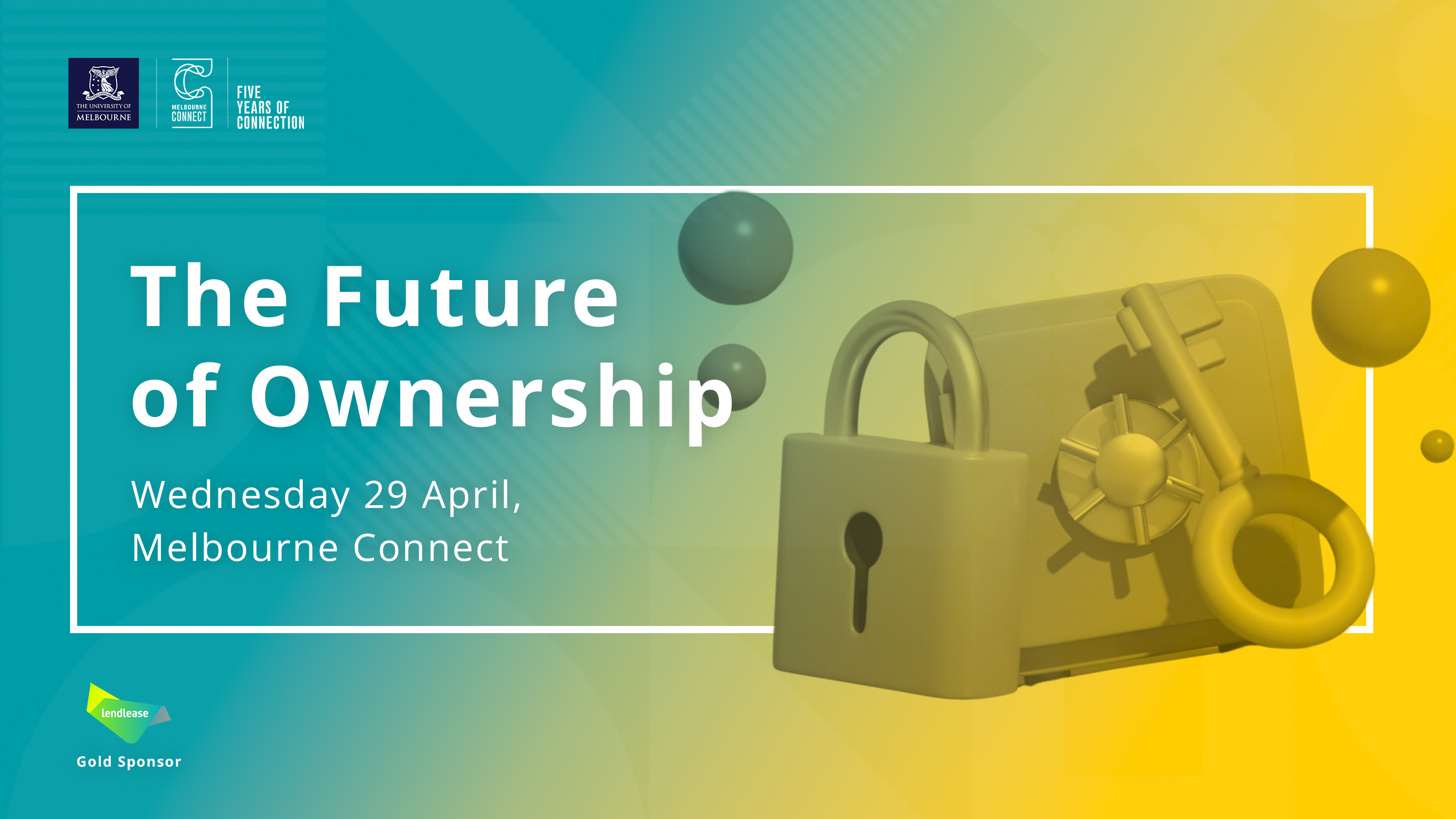
Panellists will examine how ownership operates across law, commerce, information technology, and the arts, including the role of copyright, patents, and privacy law in governing intangible assets.
The discussion will also address emerging technologies such as blockchain, ownership tokens, and smart contracts, and their implications for financial systems and control.
Bringing together experts from academia, government, and industry, this research showcase offers a forward-looking exploration of one of the most fundamental concepts shaping our future.
The Future of 2026 series is presented in partnership with Lendlease.
To better understand how local Indigenous people have navigated their stewardship of Country, we will begin the event with a Welcome to Country and smoking ceremony in the Oculus (central outdoor area). You are welcome to join us outside for a warm drink and a snack as we hear from Wurundjeri Elder Uncle Bill Nicholson. The Forum theatre will be closed at this time and will be reopen after the ceremony has concluded. Staff will be on hand at both entry points to assist with check-in and direct you to the smoking ceremony.
5pm: Doors Open - Arrive at the Oculus (ground floor central courtyard) or the Forum (Level M)
5.15pm - 5.30pm: Welcome to Country smoking ceremony in the Oculus (ground floor central courtyard)
5.30pm - 7.30pm: Main Event in the Forum (Level M)
For those who cannot attend in-person, the event will be livestreamed via the Melbourne Connect Vimeo Channel.
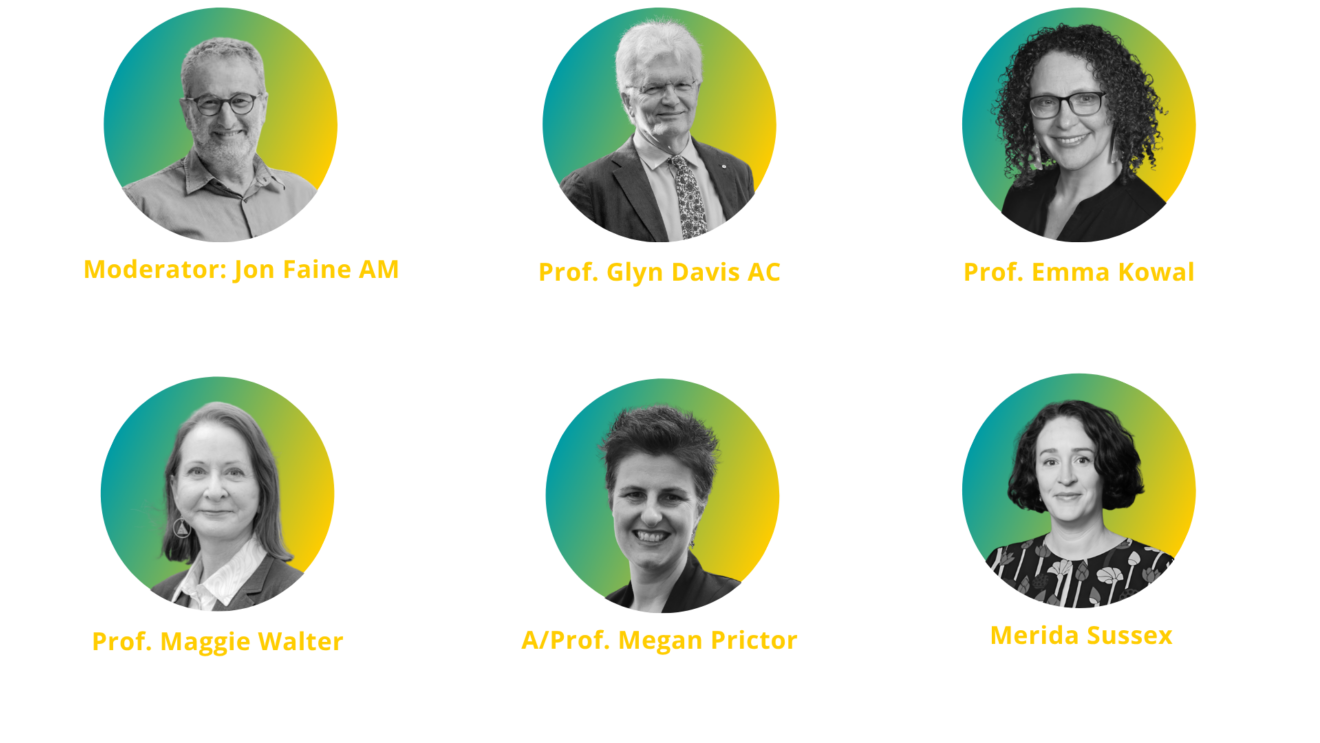

Moderator: Jon Faine AM
Jon Faine is a Vice Chancellors Fellow at The University of Melbourne for 2022 and 2023, attached to The Melbourne Law School but with a roving commission across the entire university.
Until October 2019 Jon Faine was the host of the agenda-setting morning broadcast for ABC Radio in Melbourne for over twenty years.
For over thirty years, Jon has been in demand for conference keynote speeches, presentations, facilitation, and panel moderation. Specialising in complex matters of public policy, strategy, legal issues, technological challenge or cultural clashes, his work has covered every imaginable field.
Professor Glyn Davis AC
Professor Glyn Davis AC is a public policy specialist and interim Vice-Chancellor of the University of Melbourne.
Prior to his current role Professor Davis served as Secretary of the Department of the Prime Minister and Cabinet, and Head of the Australian Public service from June 2022 until June 2025.
Professor Davis holds a first-class honours degree in Political Science from the University of New South Wales (UNSW) and a PhD from the Australian National University (ANU). In 1988, Professor Davis undertook post-doctoral studies as a Harkness Fellow, with appointments at the University of California, Berkeley, the Brookings Institution in Washington DC and the John F. Kennedy School of Government at Harvard University.
Professor Emma Kowal
Distinguished Professor Emma Kowal is Professor of Anthropology and Associate Head (Research) of the School of Humanities and Social Sciences, Deakin University and founder and Co-Convenor of the Deakin Science and Society Network. She is a cultural and medical anthropologist who previously worked as a medical doctor and public health researcher in Indigenous health. Her research interests lie at the intersection of anthropology, science and technology studies (STS), and Indigenous studies. She was previously founding Deputy Director of the National Centre for Indigenous Genomics at the Australian National University and Deputy Director of the Alfred Deakin Institute for Citizenship and Globalisation.
She is an award-winning researcher and educator, a Fellow of both the Academy of the Social Sciences in Australia and the Australian Academy of Health and Medical Sciences, a member of the Australian Research Council College of Experts, a member of the Australian Heath Ethics Committee of the NHMRC, and Past President of the Society for Social Studies of Science (4S). She is a Graduate of the Australian Institute of Company Directors and sits on multiple international editorial and advisory boards. She has authored over 150 publications including the monograph Trapped in the Gap: Doing Good in Indigenous Australia and the collection Cryopolitics: Frozen Life in a Melting World. Her latest book is Haunting Biology: Science and Indigeneity in Australia (Duke UP 2023).
Professor Maggie Walter
Maggie Walter (PhD; FASSA) is Palawa and Distinguished Professor of Sociology (Emerita) at the University of Tasmania. She is the author of seven books and over 100 journal articles and research chapters in the fields of Indigenous sociology, Indigenous Data Sovereignty and Indigenous methodology and she brings her expertise across these fields to the topic of open science and scholarship. Recent publications include Indigenous Sociology (Oxford 2023, lead editor with T. Kukutai, R. Henry & A. Gonzales) and Indigenous Quantitative Methodologies: from data deficit to data sovereignty (Routledge 2025 with C. Andersen, T. Kukutai and C. Gable). Maggie is a founding member of the Australian Indigenous Data Sovereignty Collective (Maiam nayri Wingara) and an executive member of the Global Indigenous Data Alliance (GIDA). From 2021 to 2025 Maggie was a Commissioner on the Yoorook Justice Commission, Australia’s first truth telling Commission, inquiring into injustices against First Peoples in Victoria since colonisation.
Associate Professor Megan Prictor
Associate Professor Megan Prictor is a legal academic and researcher specialising in legal issues in emerging health technologies, and the regulation of health data. She is Associate Dean of the Juris Doctor degree at Melbourne Law School, where she also co-directs the Health, Law and Emerging Technologies (HeLEX) research program. Her research expertise spans informed consent, the regulation of clinical technologies, privacy, and health data governance, with a special focus on genomics. Megan has produced over 50 peer-reviewed publications and 10 book chapters, and contributes widely to public discourse on legal issues in new health technologies.
Merida Sussex
Merida is the founder of MetaGen, a global initiative advancing data sovereignty in the creative industries, with a particular focus on music metadata and ensuring artists are paid fairly, quickly and transparently. As an artist and founder of Stolen Recordings — an award-winning independent record label established in London in 2005 — she brings lived experience to questions of creative ownership and rights.
Merida has served two terms on the boards of the Association of Independent Music (UK) and the Merlin Network. Currently she is a member of the UK Intellectual Property Office's Data Expert Working Group, established in response to the UK Streaming Enquiry, and sits on the WIPO AI Infrastructure Exchange Group. Her work sits at the intersection of policy, technology and the music industry, advocating for systems that give creators meaningful control over their work and their data.
Professor Jean-Laurent Rosenthal
Jean-Laurent Rosenthal analyses how institutions encourage long-term economic growth and wealth formation. He has studied changes in property rights at the time of the French Revolution, credit markets in Europe, law and the organisation of enterprises (in France, Germany, the United States, and the United Kingdom), and wealth inequality. Rosenthal is the author or co-author of several books including Before and Beyond Divergence: The Politics of Economic Change in China and Europe (with R. Bin Wong, Harvard University Press, 2011), and Dark Matter Credit: The Development of Peer-to-Peer Lending and Banking in France (with Philip T. Hoffman and Gilles Postel-Vinay, Princeton University Press, 2019). And A Capital’s Capital: Two Hundred Years of Wealth and Inequality in Paris (with Philip T. Hoffman and Gilles Postel-Vinay, Princeton University Press, 20206).
Professor Andrew F. Christie
Andrew Christie was the foundation appointment to the Chair of Intellectual Property in 2002.
He holds BSc and LLB (Hons) degrees from the University of Melbourne, a LLM from the University of London, and a PhD from the University of Cambridge. Admitted to legal practice in Australia and the United Kingdom, he has worked in the intellectual property departments of law firms in Melbourne and London.
He has served on all of the Australian government’s advisory committees on intellectual property – the Copyright Law Review Committee, the Advisory Council on Intellectual Property, and the Plant Breeder’s Rights Advisory Committee – and has been an expert advisor to World Intellectual Property Organization on a number of occasions. He currently chairs the Trans-Tasman IP Attorneys Board, the regulator of the Australian and New Zealand patent attorney profession.
Awarded 12 Australian Research Council grants and instrumental in winning other research funding in excess of $11 million, he has authored more than 120 publications, and delivered by invitation more than 180 public addresses in 20 countries, across all areas of intellectual property law.
Steve Vallas
CEO, Blockchain APAC
Steve Vallas is the Chief Executive Officer of Blockchain APAC, where he focuses on building credible digital asset markets through regulatory clarity, strategic engagement and disciplined execution. A qualified lawyer and management strategist, Steve works with governments, regulators, boards and founders to navigate the intersection of emerging technology, market structure and public policy.
He has led Blockchain APAC since 2018, launching the organisation with Australia’s largest enterprise blockchain event and establishing it as a convening platform for policy dialogue, market intelligence and senior level engagement. His work is grounded in local regulatory and commercial realities, informed by sustained international exposure across major digital asset jurisdictions.
Steve holds senior advisory and governance roles across the global ecosystem. He is APAC Policy Advisor to the Global Blockchain Business Council, Director of the Association for Women in Cryptocurrency and a member of ASIC’s Digital Finance Advisory Panel. He has also served on regulatory and policy committees in Canada, ASEAN and at the federal level in Australia, including as Deputy Chair of the National Blockchain Roadmap Steering Committee and CEO of Blockchain Australia.