A real commercial coding assistant tells its model that the previous version was executed for writing sloppy code. Prompts like this are increasingly common, and they are used because they visibly change model behavior. Large language models are sensitive to authority, expertise, consensus, obligation, urgency, the identities implied by a conversation, and many other social signals. They respond not only to what we ask, but also to who appears to be asking, how the request is framed, and what social meaning surrounds it.
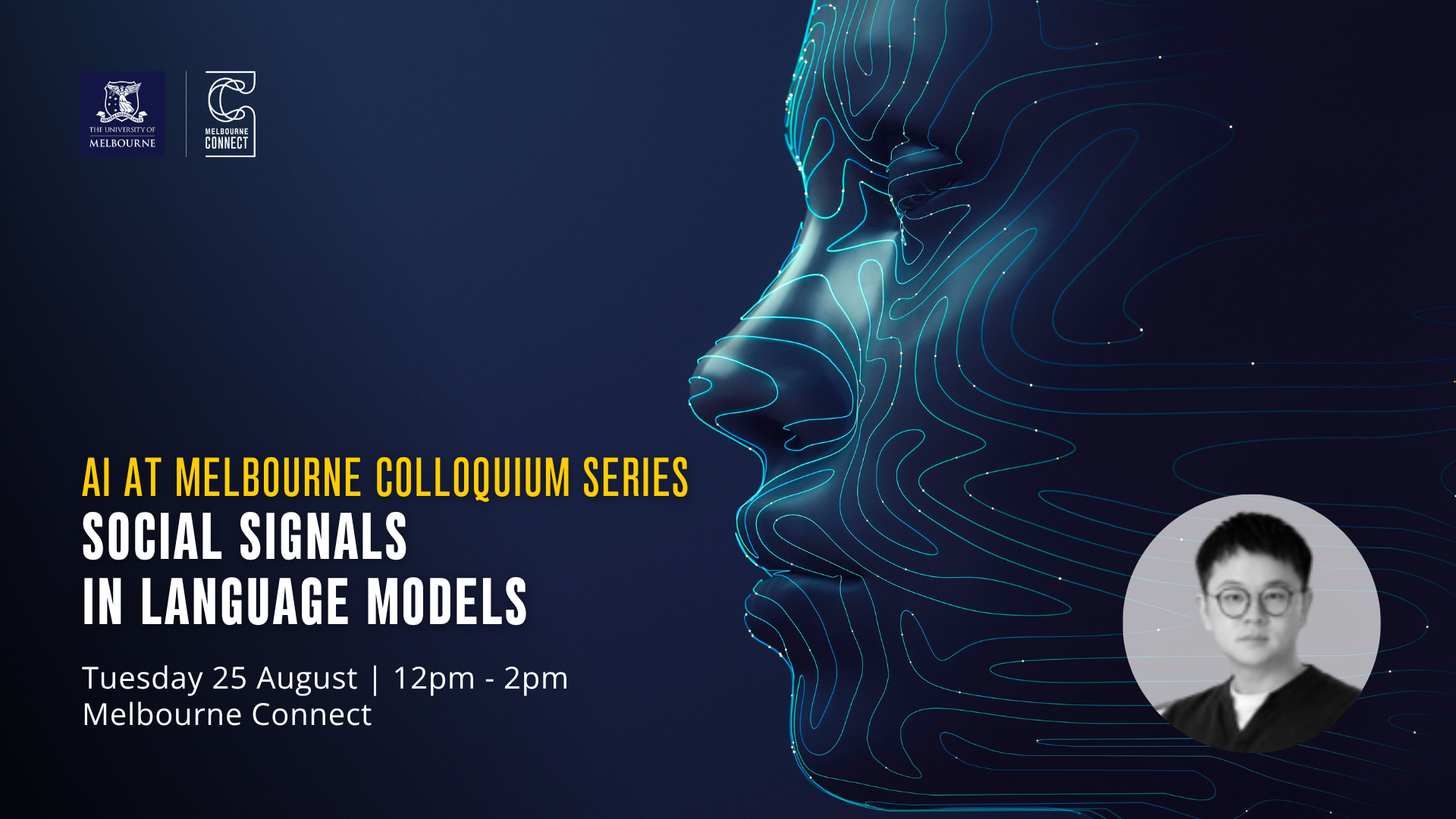
Drawing on three studies from his doctoral research, Yilin examines how these influences can be isolated, measured, and traced from model behavior to internal representation. His findings show that social signals can systematically redirect model priorities, with some proving more effective than others in a consistent pattern across models. They also show that language models reconstruct human-like structures of personality within their internal activations.
Together, his research suggests that large language models represent many of the interpersonal and social characteristics that shape our everyday interactions.
This event is presented as part of the AI at Melbourne Colloquium series at Melbourne Connect.
12pm -1pm - Keynote Presentation and Q&A
1pm - 2pm - Networking and refreshments
Yilin Geng
PhD Researcher, The University of Melbourne, Hebrew University of Jerusalem
Yilin Geng is a joint PhD researcher in NLP at the University of Melbourne and the Hebrew University of Jerusalem, working with Lea Frermann, Eduard Hovy, and Omri Abend. His research examines how large language models resolve competing instructions, respond to social and pragmatic influences, and represent human personality. His work has been published at leading AI and NLP conferences, including AAAI, COLM, COLING, NAACL, and EMNLP. Yilin received an MSE in Electrical Engineering from the University of Pennsylvania and a first-class honours BEng in Communication and Mechatronics from the Australian National University. He initially worked in nanofabrication and nanocharacterisation, before Professor Lyle Ungar inspired his transition into artificial intelligence and natural language processing during his time at Penn.
Meanwhile, Yilin co-founded the AI Development Group, now the largest student AI community at the University of Melbourne, with more than 10,000 participants. He is also a co-founder of LibrAI, an Abu Dhabi-based company developing enterprise agentic AI systems, governance tools, and AI solutions for banks and technology companies.