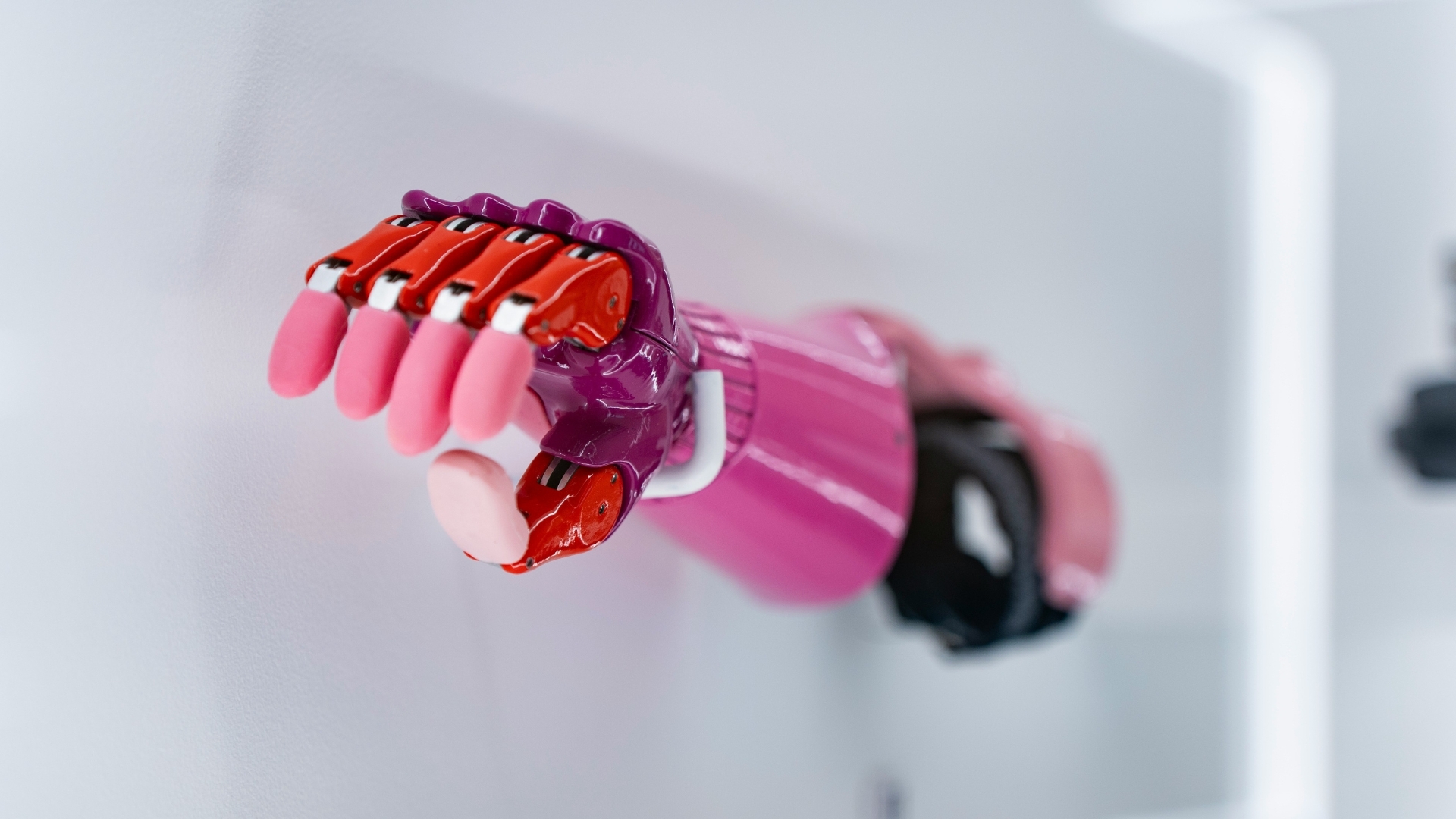
Wearable robots are changing how we move, recover, and work. Unlike rigid robotic systems, robots built from soft, compliant materials can interact with the human body more safely and intuitively — opening up applications in rehabilitation, assistive care, and industrial settings.
In this talk, Dr. Raye Yeow shares recent advances from his lab at the National University of Singapore, including soft actuator design, wearable haptic gloves, and modular exosuit architectures. He'll discuss translational platforms like the EsoGLOVE rehabilitation system and AireLevate exosuit, and offer insights into bringing wearable robotics from research into real-world deployment across healthcare, logistics, and industry.
This seminar is hosted in collaboration with ARC Training Centre for Transformative Health Sensing Technologies (C-HST). For more information, please contact deborah.mussett@unimelb.edu.au.
Intelligent wearable robotics is rapidly transforming both healthcare and industry through the convergence of soft robotics, bioinspired engineering, embedded sensing, haptics, and adaptive intelligence. Unlike rigid robotic systems, wearable robots built from compliant materials offer safer, more intuitive, and highly adaptable interaction with the human body, enabling applications ranging from rehabilitation and assistive care to industrial augmentation and immersive human-machine interaction. This talk will present recent advances from our group spanning soft actuator fabrication, stretchable and textile-integrated sensing, wearable haptic glove systems, and modular wearable robotic architectures designed for real-world deployment. Key translational platforms, including the EsoGLOVE rehabilitation system and AireLevate exosuit, will be discussed alongside emerging technologies such as scalable fluidic logic architectures, bio-mimetic olfactory sensing, and wearable drone systems for weather monitoring,. Beyond technological innovation, insights will be shared on the translation of wearable robotics from laboratory research to commercially viable and clinically relevant solutions, including manufacturability, technology readiness advancement, validation strategies, and deployment across healthcare, logistics, and industrial sectors. Collectively, these developments point toward a future where intelligent wearable robotics seamlessly augment human capability, resilience, and quality of life.
Dr Raye Yeow
Raye Yeow received his PhD in Bioengineering (NUS) in 2010, and his post-doctoral training in BioRobotics (Harvard University) from 2010-2012. He is a Dean’s Chair Professor and Deputy Head (Outreach & Industry) with the Department of Biomedical Engineering and Advanced Robotics Center, NUS, and the President of the Biomedical Engineering Society (Singapore). He was the Program Lead for the Soft and Hybrid Robotics Program under the National Robotics Programme Office in Singapore. He was a Visiting Professor at Computer Science and Artificial Intelligence Laboratory, Massachusetts Institute of Technology in 2023. His research group specializes in soft robotics, with focus on fundamental mechanisms and building market-ready systems. He has published >250 journal and conference papers, with >40 research and innovation awards, and co-founded 6 soft robotics/AI startups that are translating his technologies into the healthcare, food assembly, logistics and maritime sectors.