AI companions are rapidly becoming part of our everyday lives, reshaping how we interact with technology in a variety of contexts, from care to intimate relationships. AI companions are promoted as offering new forms of social, emotional, educational and practical support. But this is controversial. As these systems become more integrated into society, they present new opportunities but also raise important questions about connection, care, safety and responsibility.
Join researchers from the Centre for Artificial Intelligence and Digital Ethics (CAIDE) and the School of Computing and Information Systems (CIS) at The University of Melbourne for a symposium exploring this emerging field.
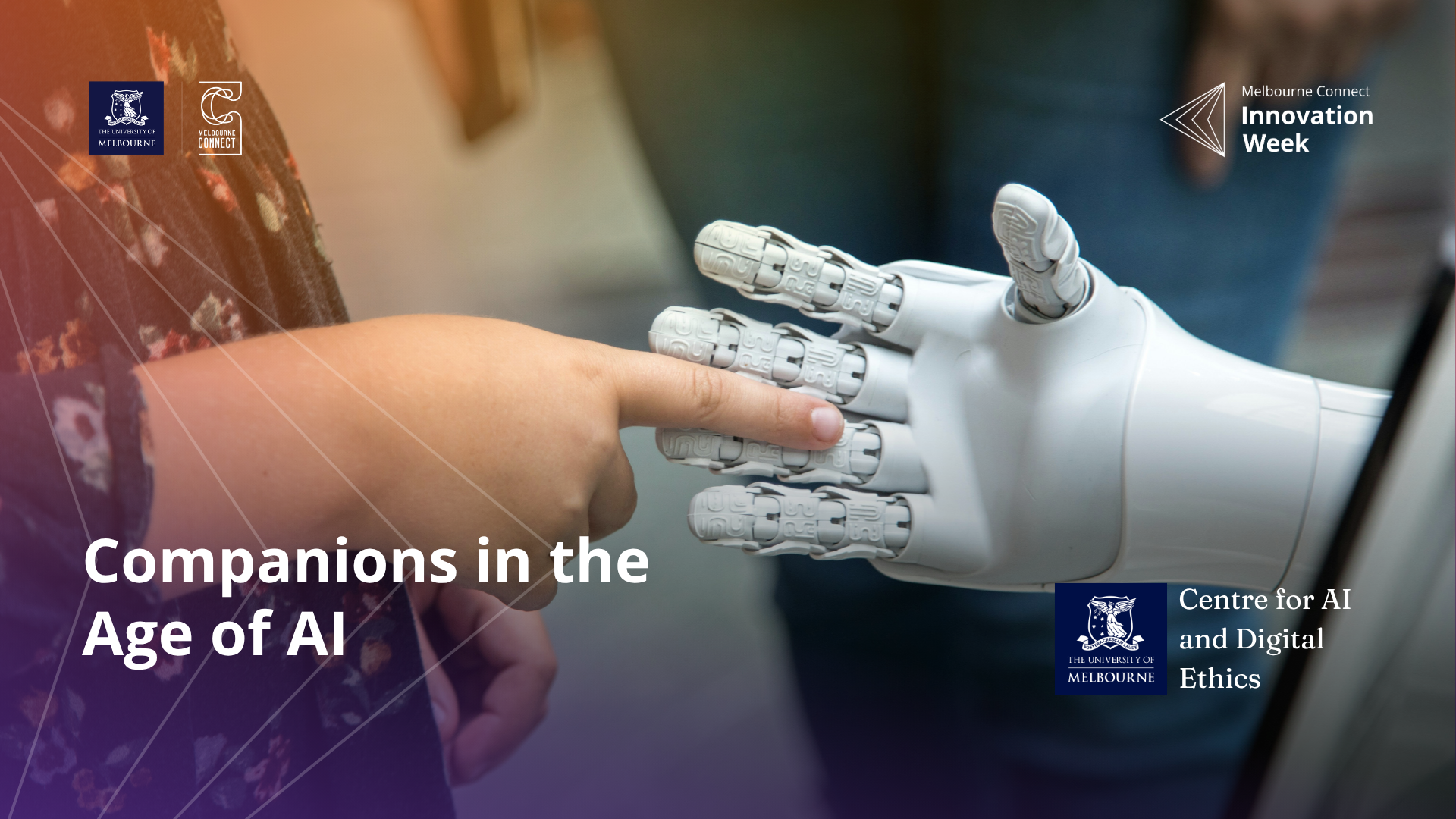
Across three panels, the day will examine AI companions for young people, applications in aged care, and the risks and regulation of AI social companions. Lightning talks and poster presentations will showcase the latest PhD research projects.
AGENDA
● 09:30 - 10:00 Doors open
● 10:00 - 11:00 Panel 1: AI Companions in Aged Care with Prof Jenny Waycott, Dr Ting Dang, Ms Catherine Parisi and Dr Marc Cheong
● 11:00 - 11:30 Morning tea and PhD poster session
● 11:30 - 12:00 PhD Lightning Talks
● 12:00 - 13:00 Panel 2: AI Companions for Younger People with Dr Simon Coghlan, Dr Eduardo Oliveira, A/Prof Roisin McNaney and A/Prof Bjorn Nansen
● 13:00 - 13:45 Lunch
● 13:45 - 14:45 Panel 3: Responsible and Safe AI with Prof Jeannie Paterson, A/Prof Greg Nyilasy, A/Prof Dr Grant Blashki and Dr Isabelle Scott
● 14:45 - 15:15 PhD Lightning Talks
● 15:15 - 15:45 Afternoon tea

Founder, BehavAI and Associate Professor
Greg Nyilasy is an Associate Professor at the University of Melbourne and Founder and Director of the BehavAI Lab, which studies how people, organisations and markets respond to artificial intelligence. His research focuses on human–AI interaction, consumer trust, responsible AI, AI-enabled decision-making and the implications of automation for work and society.

Senior Lecturer in Digital Ethics
Simon is a moral philosopher and a former veterinarian. He is a deputy director of the Centre for AI and Digital Ethics, a senior lecturer in the School of Computing and Information Systems (CIS), and associate researcher with the ARC Centre of Excellence for Automated Decision-Making and Society (ADM+S).

Professor of Law & Co-director, Centre for AI and Digital Ethics, University of Melbourne
Jeannie is a Professor of Law and Director of the Centre for AI and Digital Ethics, as well as an affiliate researcher for the ARC Centre if Excellence for Automated Decision Making and Society and a Chief Investigator for the ARC Centre of Excellence for Quality Work in the Digital Age.

Associate professor
Bjørn Nansen is an Australian Research Council Future Fellow and Associate Professor in the Human-Computer Interaction Group, School of Computing and Information Systems, University of Melbourne. He is at the forefront of international research in children’s digital technology studies, establishing the influential concept of children’s digital wellbeing, and publishing over 100 peer-reviewed publications investigating digital interfaces, platforms, and data in child and family life.

Associate Professor of digital health
Roisin is a cross disciplinary digital health researcher at the intersection of healthcare and computing science. She is director of the CSIRO Next Generation of Graduates program in AI in Mental Health, which is working with national scale organisations such as Turning Point, headspace and Orygen to develop AI driven solutions to support organisational needs.

Senior Lecturer
Dr Eduardo Oliveira is a Senior Lecturer, Assistant Director of Education, and Assistant Dean for Diversity and Inclusion at the University of Melbourne. His multidisciplinary research spans artificial intelligence, learning analytics, and software engineering. He is a Senior Fellow of the Higher Education Academy and has received the University-wide Edward Brown Award and the FEIT Kelvin Medal for Teaching and Learning Excellence.

Professor in Human-Computer Interaction
Jenny Waycott is a Professor in Human-Computer Interaction in the School of Computing and Information Systems at The University of Melbourne where she leads the Design for Ageing research theme. Professor Waycott leads interdisciplinary research projects that investigate how older adults engage with technology, particularly in aged care and community settings, and how technologies can be designed and used to support wellbeing, identity, and social connection in later life.

CEO Senatra Pty Ltd
Catherine is an experienced director and board member, with a track record spanning private enterprise, technology and the not-for-profit sector. She currently serves as a director of several companies, including board positions with Aunty Grace, a leading home care provider, and Senatra Pty Ltd, a technology company focused on improving the lives of Australians past age 65, where she is also currently Chief Executive Officer.

PhD Candidate, Faculty of Engineering and IT, University of Melbourne
Kirthika's research explores how lonely young adults interact with Large Language Models (LLMs) and AI companions and how these systems can be designed responsibly without substituting for human connection. Her motivation is to make a real impact and help people scaffold their way toward "un-loneliness".

Associate Professor
Grant is a GP and has been an Associate Professor at the University of Melbourne for over two decades, working across a range of research areas including mental health care, climate change and health, and how AI is being integrated into health care and society. He has co-edited 9 books and authored 140 peer-reviewed papers, and is a regular commentator on AI and health in the medical and general media.

Senior Lecturer, the University of Melbourne
Ting Dang's research centers on human-centered AI for health, speech and audio processing, affective computing, and wearable sensing. Her work has received multiple Best/Top Paper Awards at leading conferences and has attracted media attention, including coverage by the BBC. She was honored with the Rising Star Award in STEM, Women in Color in 2025. Her research has led to industry prototypes and patents, driving innovation in both academia and industry.

Research Fellow in AI for Digital Youth Mental Health
Isabelle is an interdisciplinary researcher working at the intersection of AI and youth mental health. She has a particular interest in how generative AI and large language models can be safely and effectively integrated into digital mental health interventions for young people, drawing on a background that spans clinical medicine, mathematics, and computer science.

Deputy Director, Centre for AI and Digital Ethics (CAIDE), University of Melbourne
Marc is Deputy Director of CAIDE and a Senior Lecturer of Information Systems (Digital Ethics). He is interested in the intersection of technology and philosophy/ethics, and he is the coauthor of the textbook Transition to Digital Ethics A Primer from Philosophy to Practice (Taylor & Francis/CRC Press, 2025). He is a frequent media commentator to outlets such as the ABC (Australia), The Age, The Conversation, Nine News, and the New York Times.