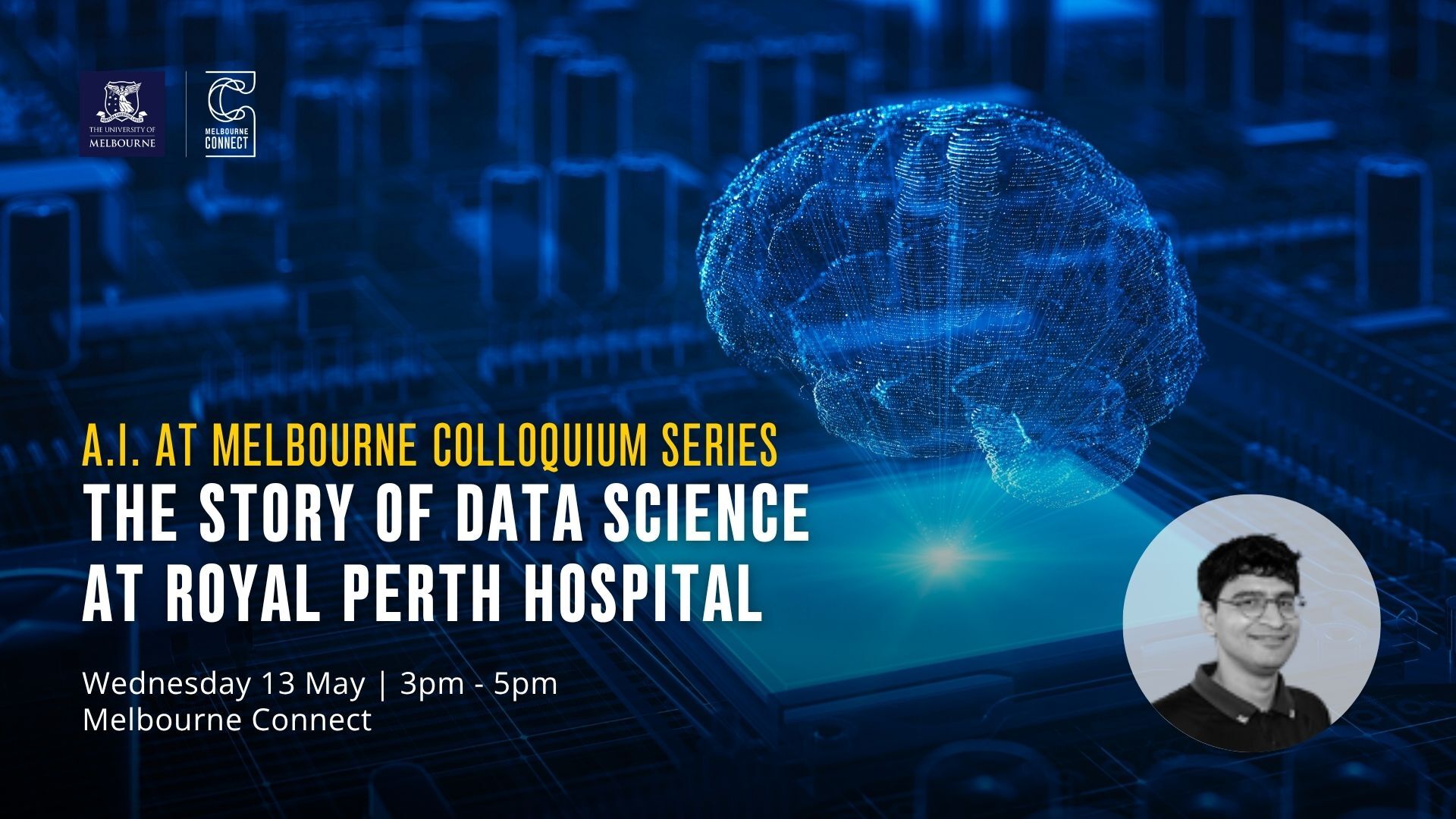
At Western Australia's first virtual hospital, data scientists, nurses, and clinicians share the same space, the same patients, and increasingly, the same tools. In this talk, Shiv Meka explores how machine learning is being applied across the entire care continuum — from predicting anxiety attacks via Fitbit data and optimising staff scheduling for home visits, to detecting cardiac and respiratory patterns simply by measuring how a patient's breathing disturbs WiFi signals in a room.
But the story isn't just about what these systems can do. It's also about where they fail — models that perform beautifully in research and quietly degrade in production. Shiv will tackle the harder questions: should we trust these systems at all, and if we believe they work, how do we bring clinicians along on that journey? A model's confidence means nothing if the nurse at the bedside doesn't act on it. He'll also examine whether detecting deterioration earlier actually leads to better outcomes, or whether earlier alerts sometimes just mean earlier anxiety.
This event is part of the AI at Melbourne Colloquium series at Melbourne Connect, co-hosted with The Faculty of Engineering and IT.
3:00–4:00pm Keynote presentation and Q&A
4:00–5:00pm Networking and refreshments
Shiv Akarash Meka
Shiv Akarsh Meka is Chief Data Scientist at East Metropolitan Health Service, where he leads a team applying mathematical modelling and artificial intelligence to patient care. His career has never quite followed a straight line, and that turns out to have been useful.
He started as an electronics engineer in India before becoming curious about the materials that electrical engineering tends to take for granted, which took him to the US where he retrained as a materials engineer and spent close to a decade working across high performance computing, semiconductor applications and computational drug discovery. The move to Australia brought a different kind of problem set: estimating the age of Martian craters, predicting when massive mine site cooling fans were about to fail, uncovering how fireflies synthesise new toxins, and optimising farm harvests using mathematical algorithms. When COVID arrived he joined WA Department of Health, identifying individuals from sparse incomplete data at the airport and combining epidemic modelling with machine learning to forecast outbreaks and ask hard counterfactual questions about interventions. He moved to Royal Perth Hospital wanting to be closer to clinicians and further from bureaucracy.
Much of his work there amounts to predictive maintenance for humans, spanning a wearable device that runs machine learning predictions using physical neural networks, a system called Sensibles that reconstructs a patient's respiratory waveform from ordinary WiFi signals, and Kimchi, a platform that turns plain language into working clinical software. He will tell you the technical problems are rarely the hardest part. Convincing clinicians to trust a prediction and reassuring his own team that the AI they are building is not coming for their jobs are conversations that never quite go away.
His research interests include physical neural networks in wearable devices, whether WiFi signals can detect polar molecules in the body, and whether machine learning can crack combinatorial problems like routing clinical staff across patients receiving hospital care at home.
His work has been supported by WA Health's FHRI, Pawsey Supercomputing, and MRFF funding, and he has published across applied machine learning, semiconductors and optimisation and has spoken at national and international forums.